One brief a day, calibrated to your baby. What is happening, what she is reading, and one thing to do today. Never homework.
Somewhere between the second pink line and the first scan, you enter a strange phase: you know something enormous, and almost nobody else does. Welcome to the secret-keeping weeks.
✅ Do this today: Agree on your "inner circle" (the one or two people, if any, you'll tell before 12 weeks) and get your cover story straight for the next dinner.
She has a shelf of apps, books and newsletters written for her. You get a congratulations and a list of things not to say. The Dad Brief is the other half of the conversation: a daily dispatch that treats fatherhood as a job worth being good at, and you as someone who will rise to it.
Every brief is two minutes, sourced, and calibrated to your exact day. Half of them are funny. The ones that shouldn't be, aren't.
The Dad Brief exists because I had just become a dad and wanted something that worked for me: a way to keep up with our baby's development, my partner, the kit, the money and my own head, without pretending my evenings were free for a parenting library.
The question that stung was "what books have you read?", because the honest answer was none. Not for lack of caring, though that's how it looked, and on the worst days it's what my partner believed too. So I built the two minutes I wish I'd had: with the first coffee, on the commute, or on the toilet. Enough to show up for your child, your partner and yourself like someone who did the reading.
Language, country, the topics you care about, and the due date. No account, no email, no password.
Two minutes, calibrated to your exact day, from week 5 of pregnancy to six months old. A nudge arrives at the hour you pick.
📖 What she's reading keeps you level with the conversation. ✅ Do this today gives you one concrete action. Never homework.
The briefs start in week 5 of pregnancy and run on your due date. A baby born early, on time or late drops onto its own track at the moment it actually arrives, and all three converge when the baby is six months old. From six months to one year, the weekly topic briefs carry on, and daily briefs for that stretch are in the making.
Built like a tool, not a toy. These are the parts that matter.
Week-by-week apps assume every baby arrives on page 40. Yours won't care. The Dad Brief tracks your baby's actual arrival and adjusts every brief to it, from the first day.
Her apps tell her something new every day. This section tells you what that is, so the evening conversation starts level instead of two chapters behind.
Every brief ends with one concrete action. Book the thing, buy the thing, say the thing. Small, daily, compounding. Never homework.
Paternity leave, insurance deadlines and allowances are national, not universal. Eight country editions plus an international one keep the admin briefs true where you live.
The due date, the birth date and your reading history live on your device and are never uploaded. No account, no tracking. Even the daily reminder was built so the server never learns your due date.
The briefs live on your phone, so the app works with no signal. Delivery-ward basements included. A daily nudge arrives at the hour you choose.
Five series. You pick what lands, all are available.
What's growing this week, with the science.
Back her up through every trimester.
Car seat, pram, cot. The right stuff only.
Leave, insurance, allowances, budgets.
Your identity, fears and mental fitness.
Alongside the daily read, the app quietly carries the tools the big day and the small hours actually call for.
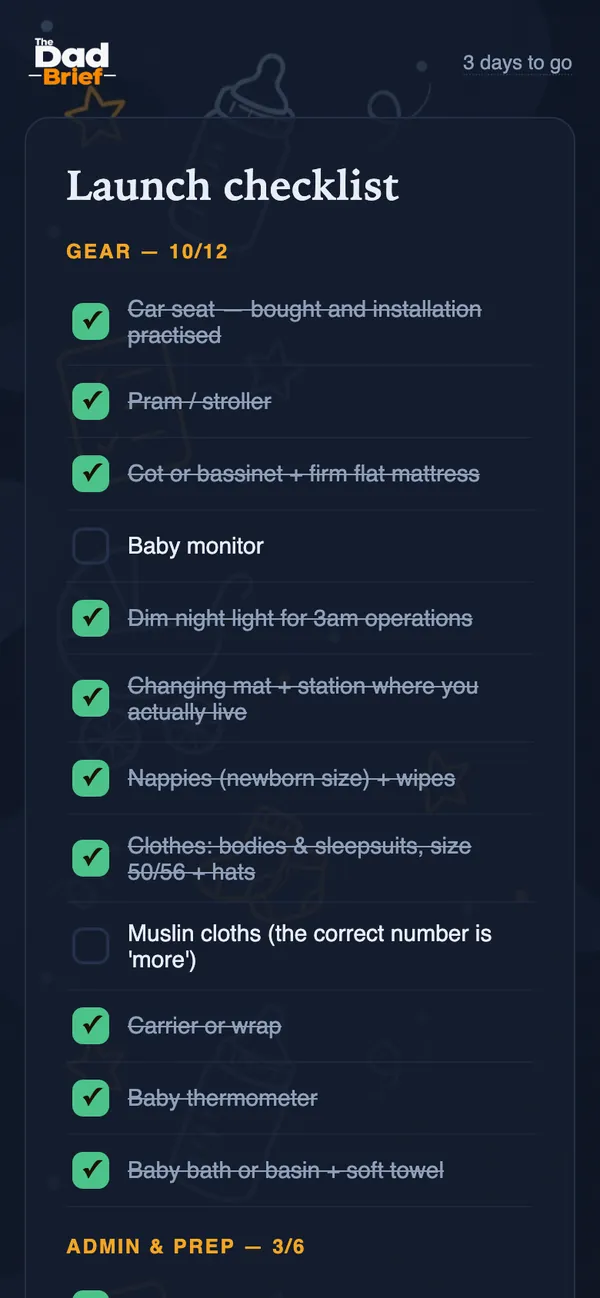
Everything to sort before the due date, ticked off at your pace.
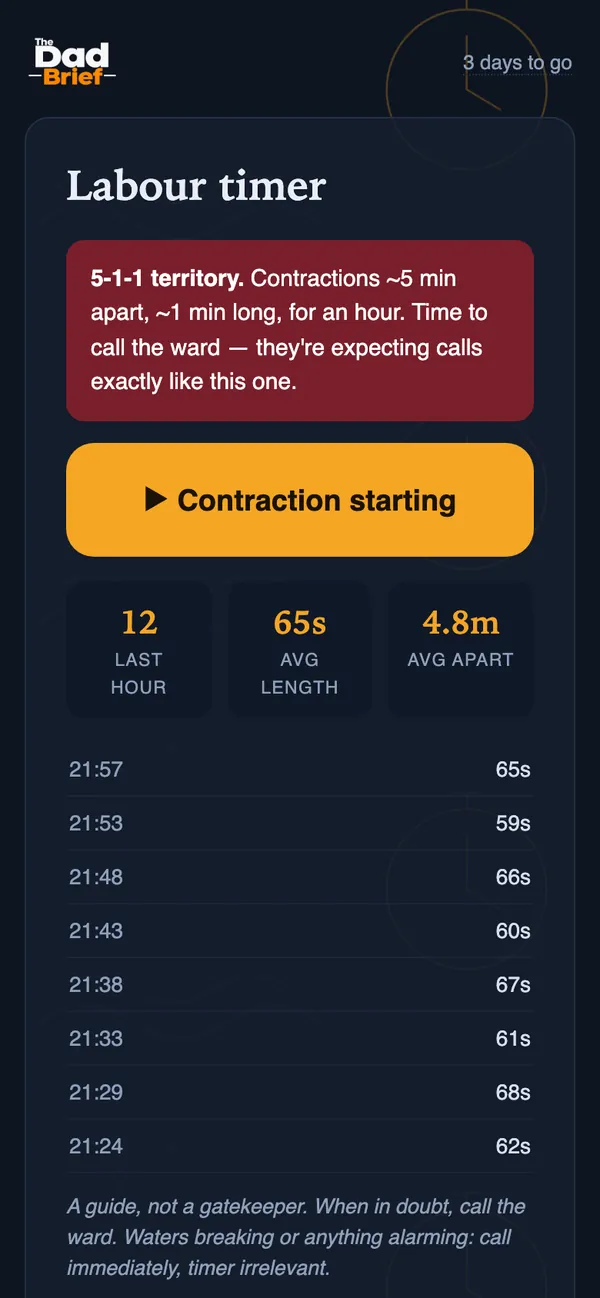
Tap, tap, and the stats tell you when it's time to call.
His, hers and the baby's, so nothing gets forgotten at 2am.
On your phone, one tap away in the delivery room.
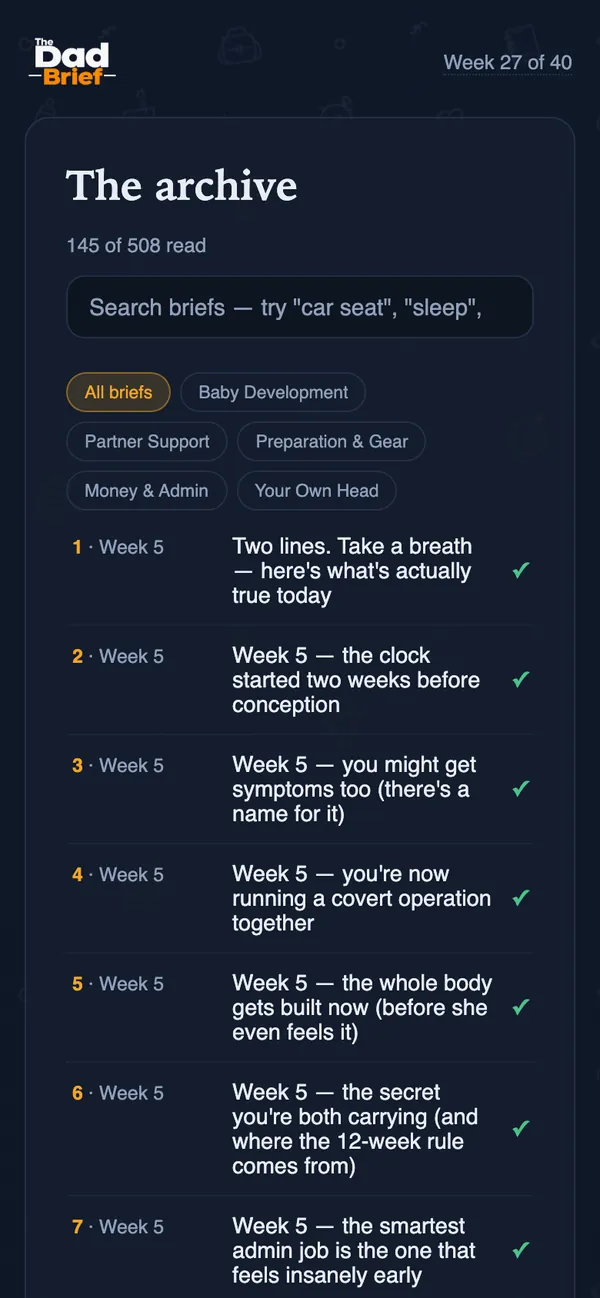
Every brief you've received, searchable by topic.
Feedback from inside the app, straight to the people building it.
…and a few more that only show up when you need them.
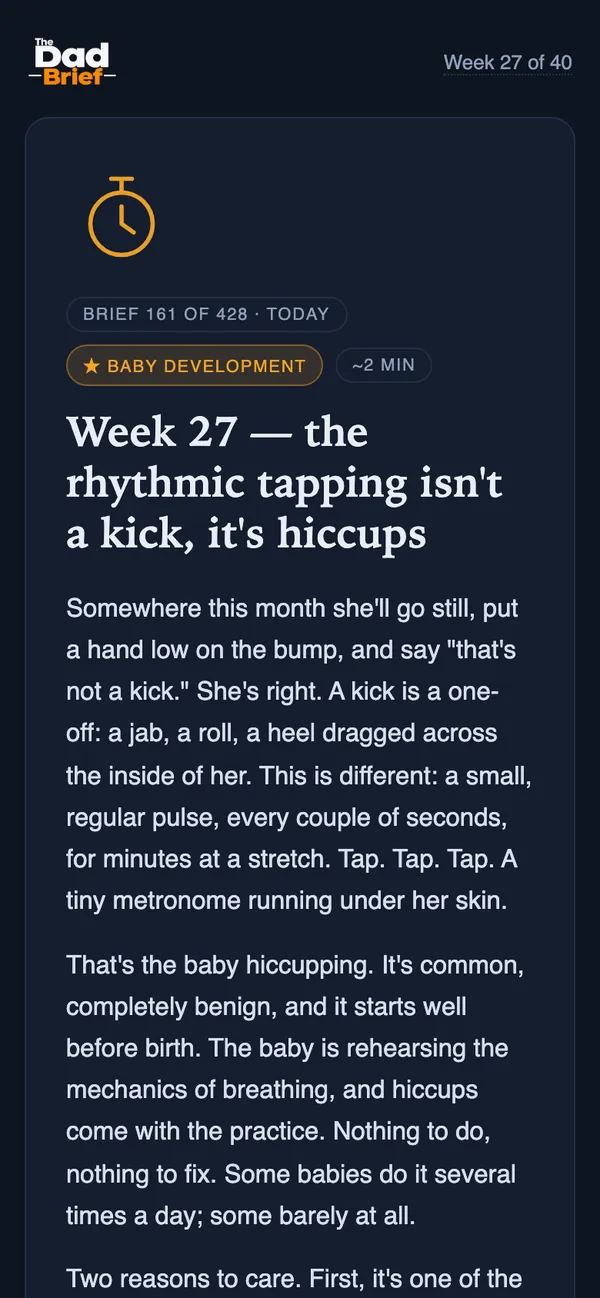
Unedited excerpts from real briefs. This is what lands each morning.
You saw it, or you will this week: a flicker on the screen, a heartbeat where two weeks ago there was almost nothing. Here's the part nobody hands you with the scan photo.
The worry you're carrying (the one you haven't said out loud, because saying it feels like tempting fate) is real, and it's normal. Early pregnancy is a held breath. But the evidence gives you something solid to hold. Miscarriage risk falls steeply across the first trimester, and it drops substantially once a heartbeat is confirmed on ultrasound (Emily Oster, Expecting Better). The most reassuring data point in these early weeks isn't a feeling. It's that flicker.
That doesn't erase the risk, and it won't stop you checking her face for bad news at every appointment. The "wait until 12 weeks to tell people" habit is convention, not a medical cliff. But the odds moved, meaningfully, in your favour this week. You're allowed to let that land.
Your job right now isn't to be the optimist or the realist. It's to be the steady one: the person who can hold both hope and caution without needing her to manage your feelings about it. She has enough to carry.
📖 What she's reading: Emily Oster's Expecting Better walks the miscarriage numbers week by week, the same data laid out so the fear has edges instead of being a fog. If she's a numbers person, this is the book that lets her exhale.
✅ Do this today: Tell her once, plainly, that you're in this with her (hopeful and steady, whatever the weeks bring) and that she doesn't owe you reassurance back.
Three days over, and worth a calm look inside, because the overdue imagination tends to fill the silence with worry, and the physiology is far more boring than the worry suggests.
Your baby is not "overcooking." They're doing what late-term babies do: gaining weight (still packing on grams daily), depositing the final layers of fat that make full-term babies such good little furnaces, growing hair and nails (post-date babies famously arrive needing a trim), and continuing to bank antibodies shipped across the placenta. Your baby is literally downloading their immune system's greatest hits until the moment of birth. The lungs, long finished, keep practising. Sleep cycles run. From the baby's side, this is bonus hotel time with room service.
The system watching over this has one honest question (is the placenta still doing its job?), and it answers that question with monitoring, not guesswork. That's what the late-term appointments are for: the CTG listens to the heart-rate pattern, the scan checks fluid levels, and both are direct readouts of how well the supply line is running. Overwhelmingly the answer is perfectly fine, which is exactly why waiting a few more days is the standard, unhurried plan.
Your two jobs stay unchanged and unglamorous: be at those monitoring appointments, and hold the movement rule. Her baby's normal pattern, any marked change, same-day call, zero hesitation. That rule is the safety net; everything else is patience.
📖 What she's reading: "is it dangerous to go overdue?" threads. The honest answer: monitored late-term pregnancy is routine; the monitoring exists precisely so nobody has to wonder.
✅ Do this today: Check the next monitoring appointment is in both calendars, and go along. Hearing that gallop on the CTG is the best morale medicine available.
Somewhere in the last month, a letter did not arrive, and that absence is the whole point. Switzerland does not automatically enrol your baby in health insurance. You have to do it, and the clock started the day they were born.
Here's the deal: you have three months from the birth to sign the baby up for basic health insurance (assurance de base / LAMal). Enrol inside that window and the cover is retroactive to day one: every check, every drop of vitamin D, every "just to be safe" paediatric visit is paid from the start. Miss it and you risk gaps in cover exactly when a small human is most likely to need it. The baby does not get a grace period for being small.
You're one month in. That feels like ages of runway. It is not. The form wants the baby's AVS/AHV number, which is issued automatically once you registered the birth. So if the birth is registered, that number is either in your hand or in the post. You can pick any insurer; choosing the same one as the rest of the household just means one login and one bill. The complementary (LCA) extras can wait. Basic cover is the deadline that bites.
This is the least glamorous job in early fatherhood and one of the most consequential. Ten minutes now buys you a covered baby and one fewer letter to dread.
📖 What she's reading Her copy of What to Expect has a tidy newborn checklist, written for a country with an entirely different insurance system. The Swiss caisse-maladie chapter is the one nobody wrote. That one's yours.
✅ Do this today Call or email your health insurer, ask for the newborn enrolment form for the assurance de base, and drop the three-month deadline into the shared calendar with a two-week buffer in front of it.
Paternity leave, insurance deadlines and allowances are different everywhere. Eight country editions plus an international one, in English and French. The other languages are being built as we speak.
Then 10 a month, in your own currency.
No card to start. Cancel anytime.
As much as she might want it to be, it's written for you. She already has a shelf of books and apps; this one is your edge and keeps you level with them. Every brief includes 📖 What she's reading, so you both stay in the same conversation.
The briefs follow your baby, not the calendar. A premature arrival switches you to a track written for exactly that, and all tracks converge when the baby is six months old.
Editions for Switzerland, the UK, the USA, Germany, France, Italy, Spain and Poland, plus an international edition for everywhere else. In English and French today, the other languages are being built as we speak.
It stays on your phone and nothing about your baby is uploaded anywhere.